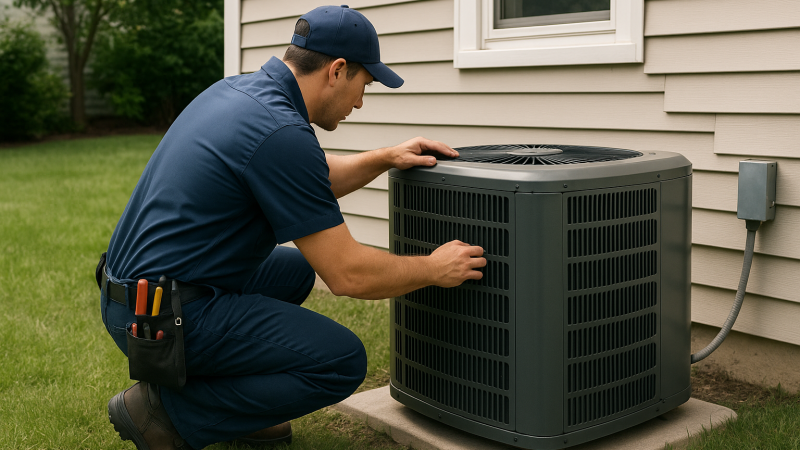
Understanding HVAC repair cost before you call a technician puts you in a much stronger position. Whether your air conditioner stopped cooling, your furnace won’t ignite, or your heat pump is making strange noises, knowing what repairs typically cost helps you evaluate quotes and avoid overpaying.
Average HVAC Repair Cost by System Type
HVAC repair costs vary significantly depending on whether you have a central air conditioner, furnace, heat pump, or ductless mini-split system. Here is a realistic breakdown of what US homeowners pay–.
Central Air Conditioner Repair Cost
- Refrigerant recharge (R-410A): $150 – $400
- Capacitor replacement: $120 – $250
- Contactor replacement: $100 – $200
- Evaporator coil cleaning: $100 – $400
- Evaporator coil replacement: $600 – $2,000
- Compressor replacement: $1,200 – $2,800
- Fan motor replacement: $200 – $700
Furnace Repair Cost
- Igniter replacement: $150 – $300
- Heat exchanger repair: $500 – $1,500
- Blower motor replacement: $300 – $700
- Control board replacement: $300 – $600
- Gas valve replacement: $200 – $600
- Flame sensor cleaning or replacement: $80 – $250
Heat Pump Repair Cost
- Reversing valve replacement: $400 – $1,200
- Refrigerant recharge: $150 – $400
- Defrost board replacement: $200 – $600
- Compressor replacement: $1,200 – $3,000
What Drives HVAC Repair Cost Up or Down?
The final bill depends on more than just the broken part. These factors have the biggest impact on your total HVAC repair cost.
Labor Rates and Location
HVAC labor typically runs $75 to $150 per hour. Urban markets and high cost-of-living states like California, New York, and Massachusetts run 30–50% higher than rural areas. Most repairs take one to three hours of labor.
Service Call and Diagnostic Fee
Most HVAC companies charge a service call fee of $75 to $150 just to show up and diagnose the problem. Some companies apply this fee toward the repair; others do not. Always ask upfront.
Parts Availability and Age of System
Older systems — especially those more than 15 years old — may require hard-to-find parts that cost significantly more. If your system is over 15 years old and facing a major repair, replacement may be more cost-effective than repair.
Emergency and After-Hours Rates
After-hours HVAC calls typically add $50 to $150 to the base rate. Summer emergency calls during heat waves can be significantly higher due to demand surges.
HVAC Repair vs. Replacement: When to Replace
A common rule of thumb in the HVAC industry is the “5,000 rule”: multiply the system’s age by the repair cost. If the result exceeds $5,000, replacement is usually the smarter financial decision.
- System age × repair cost < $5,000 → repair
- System age × repair cost > $5,000 → consider replacement
- Compressor failure on a system over 10 years old → almost always replace
- Heat exchanger crack on a furnace → replace (safety risk)
According to the US Department of Energy’s guidance on central air conditioning, modern high-efficiency systems can reduce cooling costs by 20–40% compared to older units — a factor worth considering when evaluating repair vs. replacement.
DIY Safety: What Homeowners Can and Cannot Do
Some HVAC maintenance tasks are safe for homeowners. Most repairs require a licensed HVAC technician.
Safe DIY Maintenance
- Replace air filters every 1–3 months
- Clear debris from around the outdoor condenser unit (maintain 2 feet of clearance)
- Clean or replace the thermostat batteries
- Check and reset the circuit breaker if the system won’t start
- Clean accessible evaporator coil fins with a soft brush (system off)
Leave These to a Licensed HVAC Tech
- Refrigerant handling — EPA Section 608 certification is legally required
- Electrical component replacement (capacitors, contactors, control boards)
- Gas furnace repairs involving the heat exchanger, gas valve, or burners
- Compressor or coil replacement
The ENERGY STAR program recommends annual professional HVAC tune-ups to maintain efficiency and catch problems before they become expensive repairs.
When to Call a Pro for HVAC Repair
Call a licensed HVAC technician immediately if you notice any of the following:
- The system is blowing warm air when set to cool (or vice versa)
- You hear grinding, banging, or screeching from the unit
- The system cycles on and off rapidly (short cycling)
- You smell burning or electrical odors from vents
- Ice is forming on the indoor or outdoor unit
- Your energy bills have spiked without a change in usage
Do not attempt to open the refrigerant lines, electrical panel, or gas components yourself. These repairs require licensed professionals with proper tools and certifications.
For more guidance, explore our HVAC repair resources, review our home repair cost guides, or use the HouseFixWise AI assistant to get a quick estimate. You can also browse our repair guides to find qualified local HVAC contractors.
How to Get the Best HVAC Repair Quote
Getting a fair price on HVAC repair starts with knowing what to ask. Follow these steps before authorizing any work.
Get at Least Two Quotes
For any repair over $300, contact at least two licensed HVAC companies. Prices for the same repair can vary by 30–50% between contractors. A second opinion is especially important for major repairs like compressor or coil replacement, where the cost difference can be hundreds of dollars.
Ask for an Itemized Estimate
Request a written estimate that separates labor, parts, and the diagnostic fee. This makes it easy to compare quotes and spot inflated parts markups. Most reputable HVAC companies will provide this without hesitation.
Check Licensing and Insurance
Always verify that your HVAC technician holds a valid state license and carries liability insurance. In most states, HVAC work requires a contractor’s license. Unlicensed work can void your equipment warranty and create liability issues if something goes wrong.
Ask About Warranties
Quality HVAC repairs come with a parts warranty (typically 1 year) and a labor warranty (30–90 days is standard). If a company offers no warranty on their work, that is a red flag. Manufacturer warranties on replacement parts may also apply — ask your technician to confirm.
Consider a Maintenance Agreement
Many HVAC companies offer annual maintenance agreements for $100–$200 per year. These typically include two tune-ups per year, priority scheduling, and discounts on repairs. For homeowners with aging systems, a maintenance agreement can pay for itself quickly by catching problems early.
Frequently Asked Questions About HVAC Repair Cost
What is the average HVAC repair cost?
Most HVAC repairs cost between $150 and $1,500. Minor repairs like capacitor or igniter replacement run $100–$300. Major repairs like compressor or coil replacement can reach $1,200–$3,000.
Is it worth repairing an old HVAC system?
Use the 5,000 rule: multiply the system’s age by the repair cost. If the result exceeds $5,000, replacement is usually more cost-effective. Systems over 15 years old facing major repairs are strong replacement candidates.
How long does an HVAC repair take?
Most standard repairs take one to three hours. Complex repairs like coil or compressor replacement may take a full day. Parts availability can extend the timeline if special-order components are needed.
Does homeowner’s insurance cover HVAC repair?
Standard homeowner’s insurance typically does not cover HVAC repairs from normal wear and tear. Sudden damage from a covered peril (like a lightning strike) may be covered. Home warranties often cover HVAC systems — check your policy.
How can I reduce my HVAC repair cost?
Schedule annual tune-ups to catch problems early, replace filters regularly, keep the outdoor unit clear of debris, and get at least two quotes for any repair over $300.
Conclusion
HVAC repair cost ranges from under $200 for simple fixes to over $3,000 for major component failures. Knowing the typical price range for your specific repair helps you evaluate quotes confidently and decide whether repair or replacement makes more financial sense. For more help, explore our HouseFixWise tools directory or browse our full library of HVAC guides.
HouseFixWise provides informational guidance only. For all HVAC repairs, contact a licensed and certified HVAC technician.